Verified Platforms
Quick Links
Where to Stay Secure
Thank you! Your submission has been received!
Oops! Something went wrong while submitting the form.
In Part 3, we witnessed the limits of systems that don’t connect.
Even when data exists, disconnection distorts the truth.
But commerce brings its own kind of distortion —
where the stories behind what we buy are shaped by marketing, not memory.
Because most systems still expect you to believe.
Not verify.
Now, we return to Lucia one last time —
as she learns what happens when proof becomes part of the product itself.
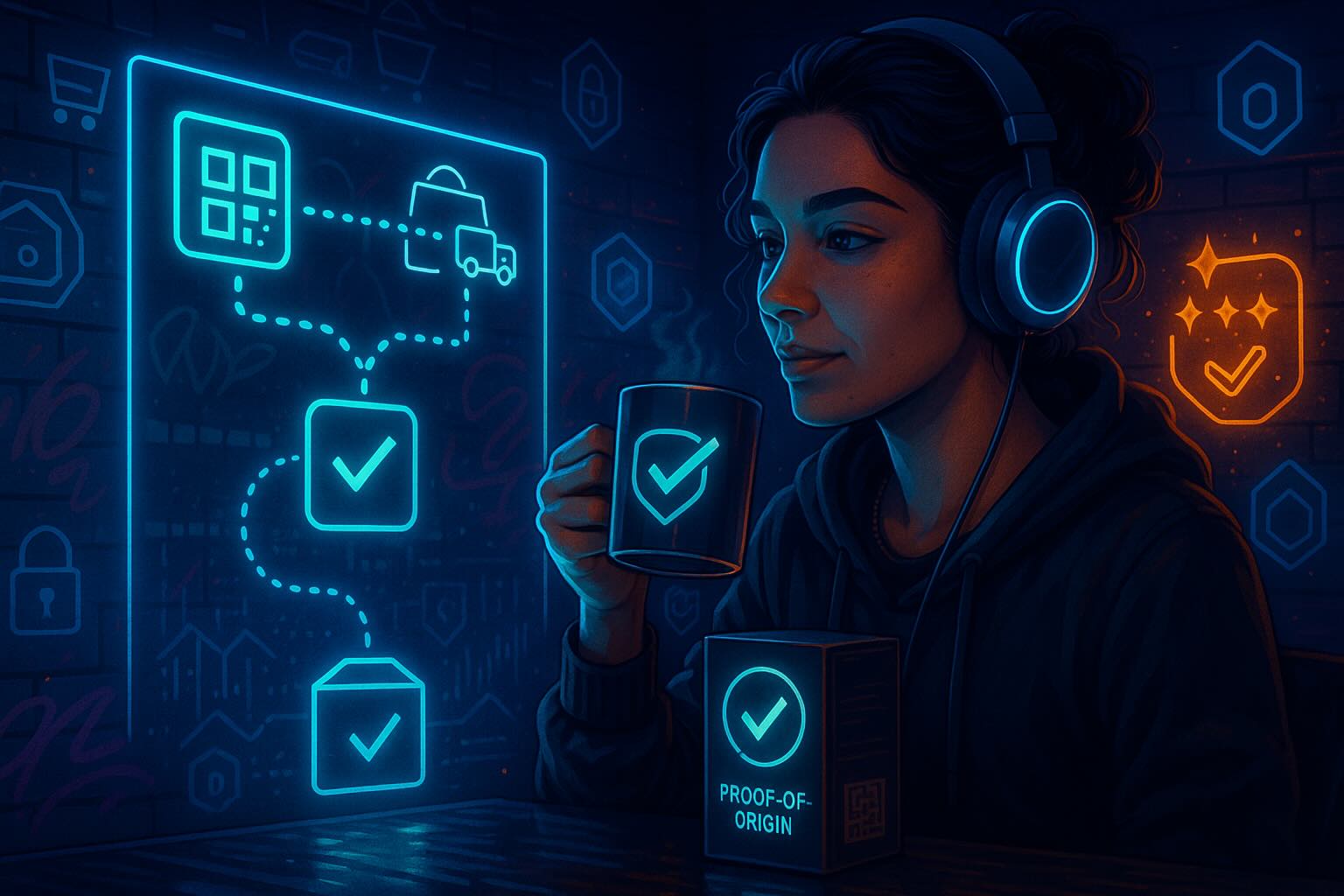
Every morning, Lucia stopped at the same market stall near her apartment. The ritual was simple: a quiet nod to the vendor, a familiar bag of roasted beans, and the reassurance that, at least here, things stayed the same. She never questioned the label. It said the right words — local, organic, fair trade — and that was enough.
Until one morning, it wasn’t.
A new bag appeared beside the usual stack. The packaging was understated, but one line stood out beneath the logo:
“Verified Origin. Tracked on Blockchain.”
Curious, she scanned the QR code. What loaded wasn’t a commercial — it was a dataset. A complete timeline detailing the beans’ journey from a farm cooperative in Minas Gerais to the Lisbon market where she now stood. It included timestamps for the harvest, batch numbers for the roast, export and import records, and confirmation of delivery.
No slogans. No marketing spin. Just a transparent chain of verification — cryptographically anchored and immune to silent edits.
That morning, Lucia didn’t just drink coffee.
She drank context — and realized how much she’d been buying blind.
The modern supply chain is vast, fragmented, and largely invisible. Nearly every item in your home — from the shirt you wear to the food you eat — has passed through dozens of hands, borders, and systems before reaching you. But in that journey, memory fades.
The problem isn’t just fraud.
It’s structural forgetfulness.
Certification schemes rely on paper trails and trust in third-party oversight. Labels like “fair trade” or “sustainably sourced” are easy to print but difficult to verify. Audits are often infrequent, proprietary, or inaccessible to consumers — and once a product is packaged, the story behind it usually disappears.
Even when companies track their logistics, the information is siloed: freight brokers log one version, customs another, warehouses a third — none of them built for public inspection. And as soon as the product changes hands, the burden of belief shifts to the buyer.
Lucia had never thought to ask for proof before.
But once she saw what real traceability looked like, she realized how little she’d known about anything she bought.
Blockchain doesn’t replace physical inspection, ethical farming, or environmental responsibility.
What it does offer is structural integrity — a public, tamper-resistant memory that turns supply claims into verifiable facts.
In a blockchain-based commerce system:
This transforms the dynamic from “trust us” to “check for yourself.”
Blockchain can’t make a product more ethical.
But it makes unethical sourcing harder to hide.
Supply chains generate enormous amounts of information — from barcode scans and shipping logs to inspection records and delivery confirmations. Storing all of that directly on a Layer 1 blockchain would be inefficient, slow, and expensive.
That’s where Layer 2 protocols become essential.
Layer 2 enables systems to store bulk data off-chain — in decentralized storage or secure databases — while publishing hashed summaries on-chain. These hashes act as fingerprints: they don’t reveal private data but can prove whether that data has been altered or falsified.
With this architecture:
Lucia doesn’t need to know how Merkle trees work or understand zero-knowledge proofs.
She only needs to scan a code and see whether what the brand claims actually aligns with what the system recorded.
A week later, Lucia is browsing an independent clothing brand online. Their homepage claims “zero-waste production” and “verified labor standards.” Normally, she’d be skeptical — but this time, a button catches her attention: “Trace the Supply Chain.”
She clicks.
What opens isn’t a brochure — it’s a structured record:
Each step is visible.
Each transition confirmed.
Nothing relies on trust in the brand — just verification from the system beneath it.
Lucia stopped reading labels.
She started reading the system behind them.
Blockchain doesn’t dismantle capitalism.
But it forces it to document itself.
Lucia now shops differently.
She avoids products that offer promises without proof.
She supports producers who don’t just talk about ethics — they show them.
She doesn’t rely on marketing.
She looks for memory.
Trust, in the Kodex view, should not be a leap of faith.
It should be a function of structure.
Blockchain isn’t magic.
But when applied with precision, it transforms commerce from performance to protocol.
Lucia doesn’t need to understand the math behind it.
She just needs a product that can back up its claims — in real time, across borders, and without exception.
This is what the future of buying looks like:
Not belief.
Verification.
And once you’ve seen one product prove its story,
you start to wonder why the rest of the world still runs on slogans.