
Verified Platforms
Quick Links
Where to Stay Secure
Thank you! Your submission has been received!
Oops! Something went wrong while submitting the form.
Lucia closed the laptop for a moment. The room fell quiet, but her thoughts didn’t. The charts had stopped moving, but the questions hadn’t.
“I keep circling back to the same worry,” she said. “Governments already control money. They decide how much exists. They regulate banks. They tax transactions. They can freeze accounts. Why would tokens be any different? Why can’t governments just shut it all down?”
Eunha’s voice stayed calm, but it carried weight.
“Because control is not absolute,” she said. “Governments can outlaw, restrict, regulate — but they cannot erase the existence of decentralized networks. Bitcoin, Ethereum — these aren’t servers in a building. They’re thousands of nodes spread across the world. To erase them, a government would have to switch off the internet itself.”
Lucia narrowed her eyes.
“But we don’t live inside blockchains. We live in the real world. If I can’t spend a token at a shop, or exchange it for money in my bank, what good is it? Doesn’t that mean governments still win?”
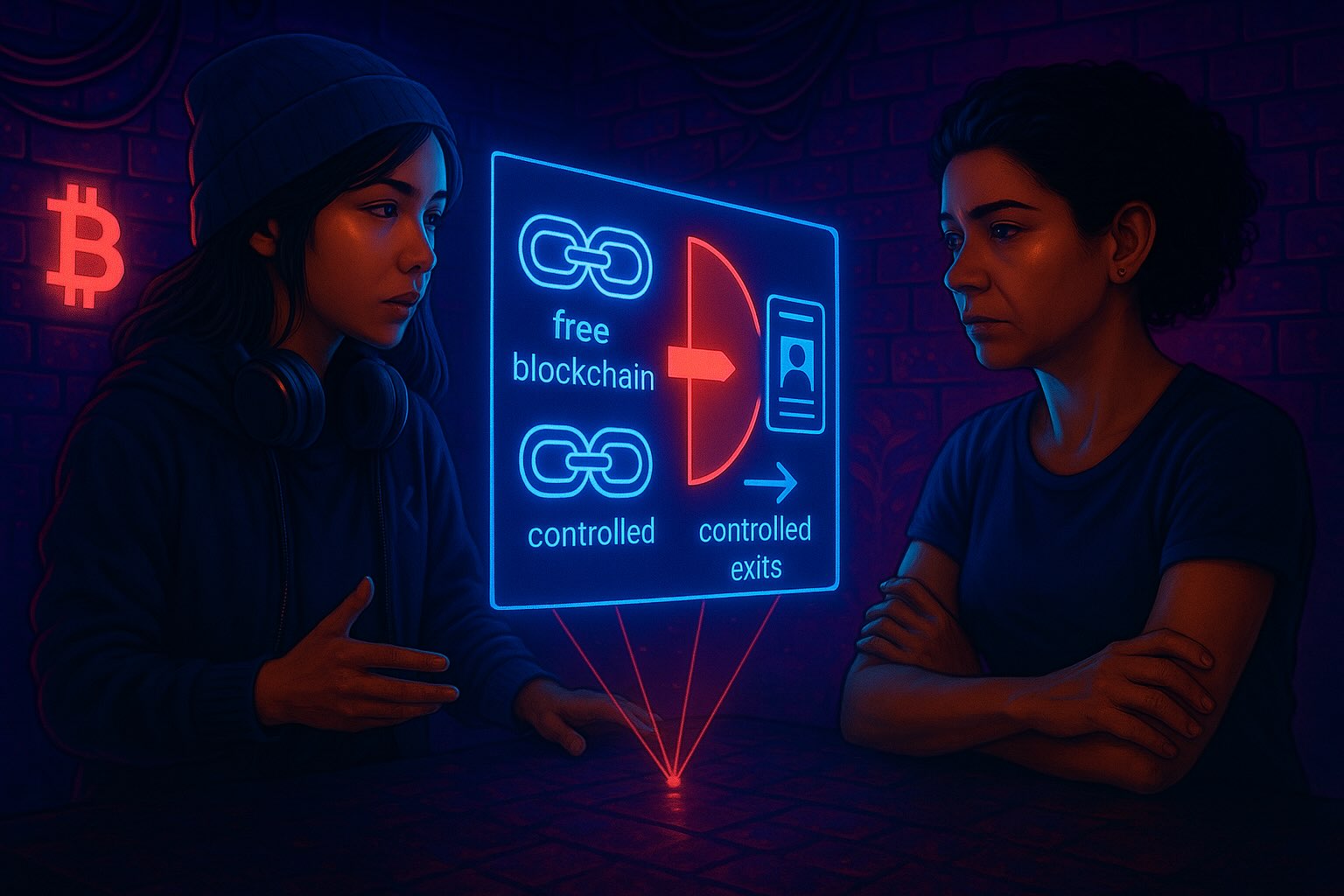
“Here you’re touching the heart of the issue,” Eunha said. “Tokens are strongest inside their networks. No one can alter the ledger. No one can inflate the supply without consensus. But at the borders — where tokens meet fiat — governments still have power. They control the on-ramps and off-ramps: exchanges, banks, payment companies. They can demand KYC, freeze withdrawals, blacklist addresses. They can’t break the code, but they can choke its use.”
Lucia drummed her fingers, frustration deepening.
“So decentralization is a half-truth,” she said. “On paper it’s freedom — but in practice the state just waits at the exit. If I can’t convert, if I can’t spend it openly, isn’t it all just an illusion?”
“Not illusion,” Eunha replied. “Tension. Think of cash. Governments control banking systems — yet black markets still run on paper money, because physical cash resists surveillance. Tokens are similar. They can be banned, but they go underground. They can be taxed, but they can move peer-to-peer across borders. They don’t erase governments — and governments can’t erase them either.”
Lucia tilted her head.
“Then why haven’t more governments already crushed them? If tokens are so disruptive, why let them exist at all?”
“Because power moves in more than one direction,” Eunha said. “Some governments see tokens as innovation — a way to attract capital and talent. Others treat them as laboratories: open experiments they can study, copy, or absorb. Some simply lack the technical or legal ability to enforce bans. And others realize that regulation, not destruction, gives them more control.”
Lucia raised an eyebrow.
“Regulation. That word is everywhere. But what does it actually mean for tokens? Taxes? Bans? Licensing? What shape does it take?”
“All of those,” Eunha said. “In Europe, the MiCA framework classifies tokens — stablecoins, utility tokens, asset-backed tokens — and demands disclosures, audits, reserves. In the U.S., the debate is fragmented: the SEC claims many tokens are securities, others argue they’re commodities. Stablecoins face the tightest grip, because they compete with government money. Everywhere, regulation is code for surveillance — KYC, AML, traceability. The more tokens touch the fiat world, the more the state insists on control.”
Lucia’s tone hardened.
“And what about CBDCs? Central Bank Digital Currencies. Aren’t they just governments taking the tech and keeping all the power?”
“CBDCs are the mirror opposite of tokens,” Eunha said. “Where tokens try to decentralize, CBDCs centralize completely. They adopt blockchain mechanics — programmability, instant settlement, audit trails — but strip away freedom. With a CBDC, every transaction is visible to the state. Money can be frozen, expired, geo-restricted. Tokens tried to escape authority. CBDCs embed authority deeper.”
Lucia leaned forward, eyes sharp.
“So tokens are just fuel for the state’s next machine. People thought they were building freedom — but governments are harvesting the same tools to build surveillance. Isn’t that defeat?”
“Not defeat,” Eunha said. “Dialectic. Every new tool reshapes power in both directions. The internet empowered individuals — and also surveillance states. Encryption protected privacy — and also intelligence agencies. Tokens unlock new possibilities for freedom — and new instruments for control. The question isn’t ‘who wins?’ — it’s who adapts faster.”
Lucia went quiet, then spoke softly.
“But what about me? An ordinary person. If governments demand taxes, if exchanges require IDs, if banks block withdrawals — do I really have decentralization left?”
“Inside the system, no,” Eunha said. “But peer-to-peer, outside exchanges, autonomy still exists. If you and someone else agree, no government can stop you from sending a token directly. The chain will confirm the transaction. That freedom is fragile. Sometimes inconvenient. Sometimes punished. But it remains. Decentralization is not a blanket of protection. It’s a door that stays open — even when every hallway around it is walled.”
Lucia’s voice grew reflective.
“So decentralization isn’t perfection. It doesn’t erase power. It doesn’t make me untouchable. What it gives is persistence — the ability to survive pressure, to move underground, to exist in parallel.”
“Yes,” Eunha said. “That’s its real meaning. Not invincibility — endurance. Governments can regulate, restrict, surveil. Tokens can adapt, fork, migrate, reappear. Neither side wins absolutely. Both evolve.”
Lucia leaned back slowly.
“Then tokens aren’t just code and markets. They’re political events. Each one is a negotiation — between networks and states, between freedom and control. And that negotiation never ends.”
“You’ve understood it,” Eunha said. “To study tokens is to study power. Code is the medium. Markets are the stage. Governments are the counterforce. Decentralization isn’t victory — it’s resistance.”
Governments cannot erase decentralized tokens, but they can choke them at the borders — banks, exchanges, payment rails. Decentralization resists, but it is fragile in practice. Regulation brings surveillance. CBDCs copy crypto’s architecture but invert its spirit. Tokens are not just code — they are contests of power, surviving not through perfection, but through persistence.