
Verified Platforms
Quick Links
Where to Stay Secure
Thank you! Your submission has been received!
Oops! Something went wrong while submitting the form.
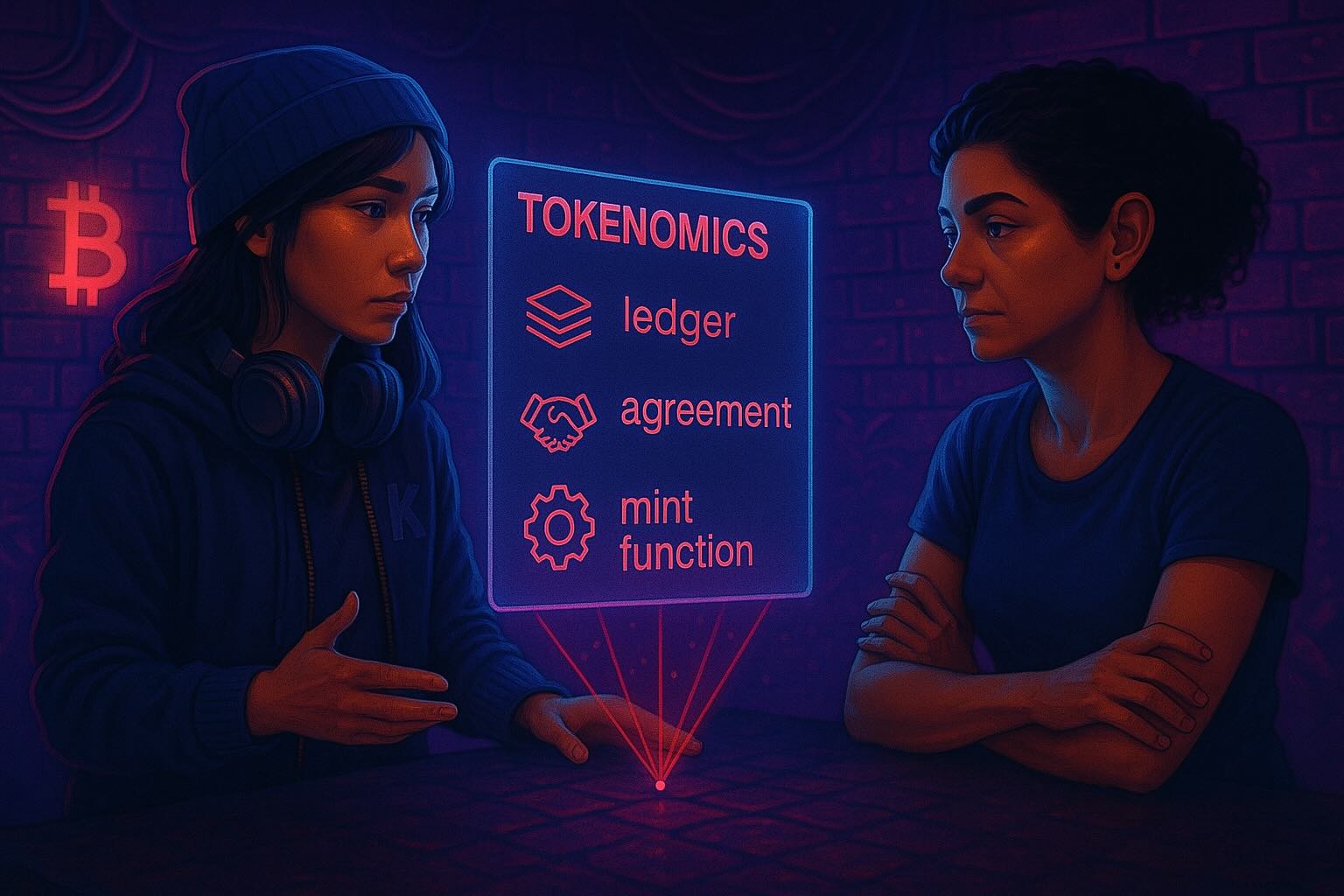
Lucia stared at the chart again. A green candle stretched upward, then was crushed by a wall of red.
“I can accept now that a token is just a record in a ledger,” she said. “But the chart keeps mocking me. If a token is only numbers in code, how can it have a price? A stock has value because it connects to a company. A bond has value because it promises repayment. Gold has value because it’s scarce and physical. But a token? Where does its value sit? In the code? In my wallet? In some vault somewhere? Or nowhere at all?”
Eunha didn’t answer immediately.
“Let me ask you something,” she said. “If someone pays ten million dollars for a painting, where is the value? In the canvas? In the paint? In the wood of the frame?”
“No,” Lucia said. “In the story. In what people believe it’s worth.”
“Exactly,” Eunha replied. “Tokens are the same. The value is not inside them. They don’t contain reserves or metal or profit streams by default. Their worth comes from what people are willing to exchange for them — the agreement between buyer and seller. Sometimes that agreement is anchored in utility or backing. Often it is only belief.”
Lucia frowned. “But if it’s only belief, that feels dangerous. At least with a painting, there’s something on the wall. With a stock, I can trace back to buildings and workers. With bonds, I can demand repayment. With gold, I can weigh it in my hand. When I buy a token, what am I really holding? Where is the something?”
“In most cases,” Eunha said, “nowhere. A token is not a container of value. It is a marker in the ledger. The value lives outside it — in the demand of others, in the liquidity of markets, in the story told around it. Some tokens are linked to bank reserves, like stablecoins. Others are linked to code in smart contracts — lending systems, staking, governance. But many are linked to nothing at all. They exist only as entries people trade back and forth.”
Lucia leaned in. “Then answer me plainly: when I pay money for a token, where does my money actually go? Into the token? Into the project? Who holds it?”
“If you buy on a centralized exchange,” Eunha said, “the answer is simple: it goes to whoever was selling at that price. The exchange matches you. You get their token. They get your money. The exchange just sits in the middle until you withdraw.
On a decentralized exchange, it’s different. You’re not buying from a single person. You’re trading against a liquidity pool — tokens deposited by many users into a smart contract. You give your tokens in, you get others out. The balances shift, and the liquidity providers earn fees for supplying the pool.”
“So in both cases,” Lucia said, “my money doesn’t go inside the token. It just flows to someone else — a seller, or a pool of strangers.”
“Exactly. A token is not a vault. It doesn’t store the dollars you paid. The ledger only records who owns the token. The money you spent has already moved on to someone else.”
Lucia tapped her fingers on the desk.
“So when people say a token’s value is rising, they don’t mean the token itself has gained anything. They mean more people are willing to pay more for it.”
“Correct,” Eunha said. “The token doesn’t swell with value like a balloon. It’s the same line in the ledger, unchanged. What changes is the market’s opinion. The price is just the last trade — the most recent handshake between buyer and seller.”
Lucia’s voice sharpened.
“Then why do people worship the number? I scroll through feeds and see charts treated like holy scripture. ‘This token is worth a thousand dollars!’ As if price is truth, not just agreement.”
“Because price feels solid,” Eunha said. “It compresses chaos into one number. It looks like certainty. But in reality, price is fragile. It is not the voice of truth — only the echo of trades. And trades can be honest or manipulated.”
Lucia sat up straighter. “Manipulated how? If the ledger is secure, how can the price be fake?”
“Because the ledger records the transaction, not the intent,” Eunha said. “A whale can flood the order book with buys, push the price up, then dump. A project can fake liquidity, inflate demand, or quietly sell into its own market. On DEXs, liquidity can disappear in seconds — leaving buyers with tokens they can’t exit. The trades are real. The story they tell is not always honest.”
Lucia exhaled.
“So the chart is a stage. The number is a performance. Behind it, whales and insiders may be pulling strings. And the token itself never changes — only the belief around it.”
“Exactly. The token stays the same record: this address owns this much. But markets turn that record into theater. Sometimes the theater is fair. Often it’s distortion. The wise don’t read the chart as scripture. They ask what forces shaped it.”
Lucia stared at the flickering candles again, but this time with colder eyes.
“So the truth is simple, but harsh. A token has no value stored inside it. When I buy, my money just moves to someone else. When I sell, theirs moves to me. The price is not truth. It’s just the last agreement — and that agreement can be built on fear, greed, or manipulation just as easily as real demand.”
“You see it,” Eunha said. “And seeing it frees you. Next time you look at a chart, remember: the number is only a mask. The substance is underneath — in code, in liquidity, in power. Ask who is buying, who is selling, and why. Without those questions, the number is noise.”
A token is not a vault of value. Its price is not truth. Price is only a reflection of trades — money changing hands between holders, sometimes honest, often engineered. The ledger records ownership, but belief, demand, and power decide price.