Verified Platforms
Quick Links
Where to Stay Secure
Thank you! Your submission has been received!
Oops! Something went wrong while submitting the form.
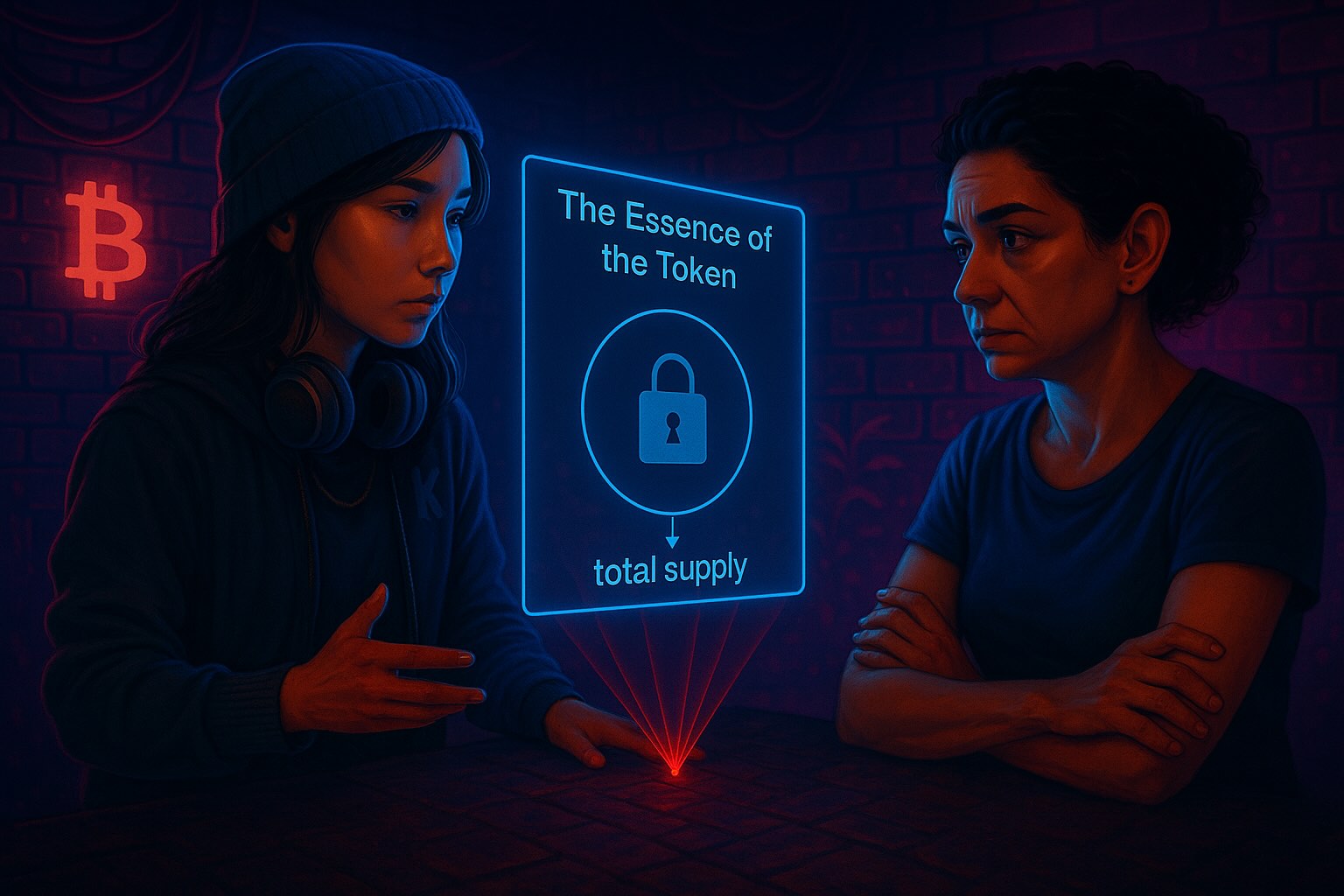
The candles on Lucia’s screen seemed calmer now, but the numbers still gnawed at her.
“There’s another part I can’t make sense of,” she said. “Everywhere I look, people talk about supply. Bitcoin has a fixed cap — twenty-one million. Some tokens mint endlessly. Others brag about burning half their supply to make the rest more valuable. I don’t know what to believe. Where does this supply come from? Where does it live? And who controls whether it changes?”
Eunha folded her hands.
“The supply of a token is defined in its code,” she said. “In Bitcoin, the issuance schedule is part of the protocol itself: new coins are minted with each block, and the reward halves every few years until no more can ever be created. That rule is woven into the network’s consensus. No single person can change it. That’s what people mean when they talk about fixed supply.”
“So Bitcoin’s scarcity is real,” Lucia said. “Not just marketing — twenty-one million is hard-coded.”
“Yes,” Eunha replied. “Unless the majority of the network agreed to rewrite the rules — which would destroy trust — that limit stands. That’s digital scarcity, enforced by code instead of vaults.”
Lucia tilted her head.
“But not all tokens are like that. Some projects mint new coins every day. Some change supply whenever they feel like it. Why would anyone accept that?”
“Because some tokens are meant to be elastic,” Eunha said. “Stablecoins, for example, expand when demand rises and shrink when users redeem them. Their purpose is stability, not scarcity. Other tokens use inflation to reward participants or secure the network. Flexibility isn’t always corruption — sometimes it’s design.”
Lucia tapped her desk, thinking.
“Alright, but what about the scams? I’ve seen projects boast about ‘hard caps,’ and then the developers mint billions more overnight. How is that possible if supply is supposed to be in the code?”
“Because the code allowed it,” Eunha said. “Many contracts contain mint functions — commands that let an administrator create more tokens at any time. Unless those functions are removed or locked, the promise of scarcity is just words. The blockchain will enforce whatever the contract says, even if it says unlimited minting.”
Lucia’s voice sharpened.
“So immutability doesn’t protect me if the rules themselves are rotten. If the contract says the admin can mint, then the chain will enforce it. Not a bug. A feature — for them.”
“Exactly,” Eunha said. “The chain never lies. But it can be used to enforce a lie.”
Lucia exhaled slowly.
“And the burning? I’ve seen tokens brag about destroying half their supply, like that automatically makes the rest worth more. Is that real?”
“Sometimes,” Eunha nodded. “A true burn sends tokens to an address with no private key — effectively removing them from circulation forever. But sometimes the burn is theater. Numbers are adjusted in a database. Or tokens are sent to an address controlled by insiders. Scarcity is promised, but not delivered.”
“So the word ‘burn’ doesn’t always mean destruction,” Lucia said. “It can mean sleight of hand. And unless someone can read the contract, they’ll never know the difference.”
“Exactly,” Eunha replied. “Scarcity can be truth, or illusion. The chain will record whichever version the contract orders. The responsibility is on the observer to ask: Is this rule genuine — or a mask?”
Lucia leaned back, staring at the ceiling.
“So the whole story of supply is fragile. Bitcoin’s fixed limit is real because no one controls it. Stablecoins flex because that’s their purpose. But everything else? It could be honest — or it could be a trap written in code. And the market will believe the promise… until it doesn’t.”
“You see it,” Eunha said. “Supply is not always scarcity. It is a design choice. And every design hides power — surrendered or retained. Whenever you hear ‘fixed supply,’ you must ask: fixed by whom? fixed how? and can that fix be broken?”
Lucia looked back at the screen. The numbers no longer felt simple. Behind each was a shadow: how many existed, how many could still be created, and who held the lever.
Supply does not live in vaults — it lives in code. Some rules enforce hard caps, like Bitcoin. Others allow elastic creation, like stablecoins. Many hide mint functions or fake burns that turn scarcity into illusion. The real question is never “what is the supply?” but who controls it — and can they change it?
Lucia now understood the internal anatomy of a token.
It wasn’t a coin in a vault — it was a record in a ledger.
Its price wasn’t stored inside it — it was a reflection of belief and trade.
Its supply wasn’t always sacred — it could be fixed, elastic, or quietly manipulated in code.
She had seen the mechanics:
what a token is, how it gains a price, and how its supply can be built or abused.
But something deeper had begun to bother her.
If tokens live in code,
who controls the code?
If blockchains claim immutability,
who still holds the power to change the rules?
If tokens claim freedom,
what happens when governments step in?
She had learned how tokens work.
Now she needed to learn how they survive.
The dialogue had reached its edge.
Inside the token, the rules were written.
Outside the token, other forces waited —
law, power, regulation, ideology, enforcement.
And so the conversation would shift:
from the token itself…
to the world that surrounds it.
Part 2 begins.