
Verified Platforms
Quick Links
Where to Stay Secure
Thank you! Your submission has been received!
Oops! Something went wrong while submitting the form.
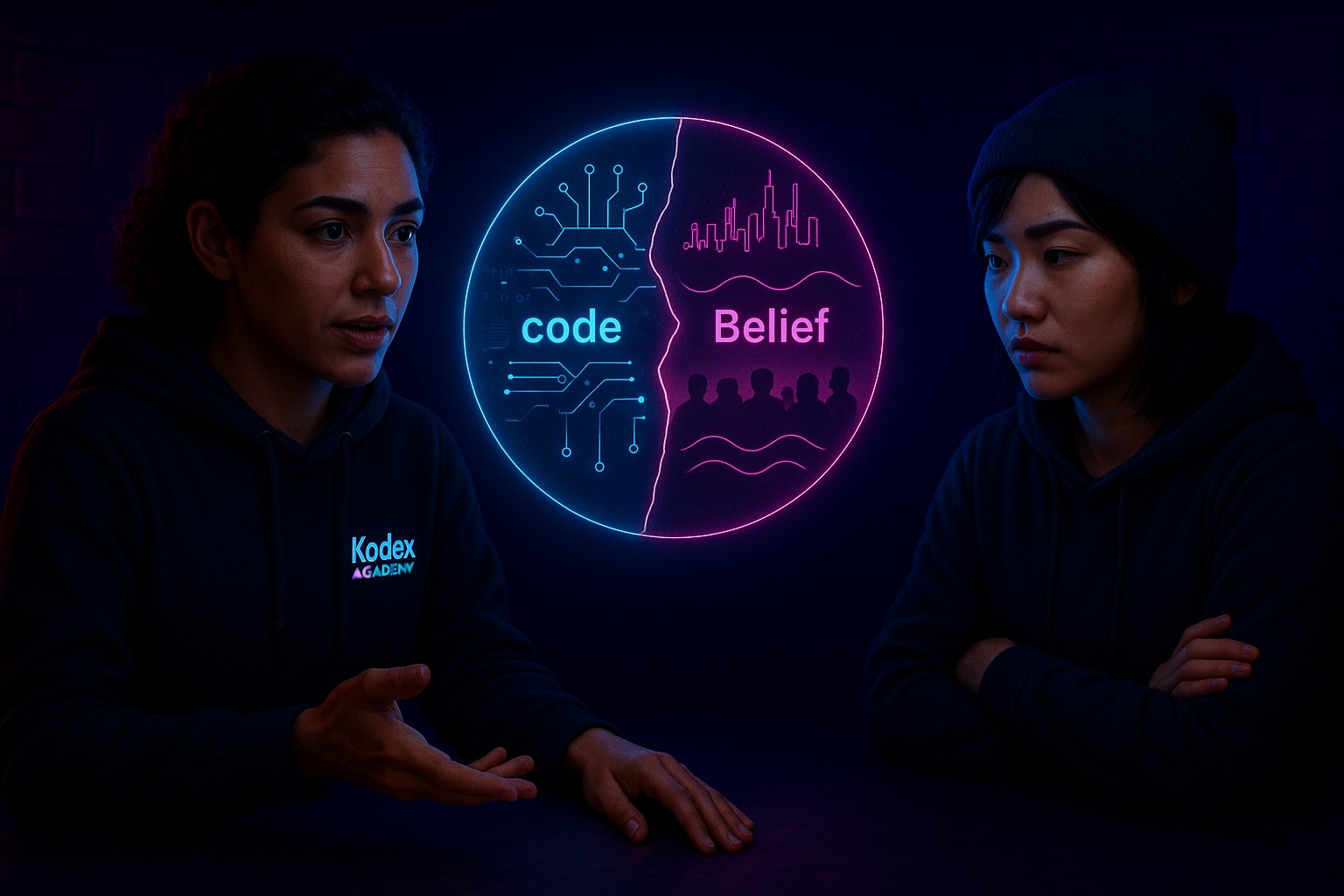
The screens around them still pulsed with numbers - green and red candles flashing in their endless rhythm. But the market’s noise felt muted now, drowned out by the weight of everything that had been uncovered.
Lucia leaned forward, her voice steady but searching.
“I’ve pressed you from every angle,” she said. “I’ve asked what tokens are, how price works, how supply is written, whether immutability is real, how governments push back, and how tokens compare to money, stocks, bonds, and gold. Every time, the answers have been layered, uncertain, complex.”
She paused.
“So I have to ask the hardest question: when everything is said and done… are tokens real? Or are they just illusions dressed as value?”
Eunha didn’t answer immediately. She watched Lucia for a long moment.
“They are real,” she said at last. “And they are illusions. Real, because they exist, because code enforces them, because markets trade them, because power fears them. Illusions, because their price is fragile, their promises often hollow, their meaning borrowed from older systems. They are both — and to see them clearly, you have to hold both truths at once.”
Lucia frowned.
“That sounds like a paradox. How can something be both real and illusion?”
“Consider money itself,” Eunha said. “A piece of paper, printed with numbers. Worthless by nature. Priceless by decree. Real in the marketplace — illusion in its substance. Consider stocks: certificates that promise ownership, but only as long as courts and regulators uphold them. Consider gold: trusted for five thousand years, yet still driven by belief. Every asset has illusion woven into its reality. Tokens are simply more honest about their fragility — because nothing disguises it.”
Lucia’s voice sharpened.
“Then why not abandon them? If they’re fragile, if scams and manipulation and regulation can crush them, why care? Why risk believing at all?”
“Because they open a door that cannot be closed,” Eunha said. “Before tokens, all money, all ownership, all credit lived inside institutions — banks, governments, courts. Now, there is an alternative. Imperfect, fragile, sometimes corrupted — but undeniable. A parallel system. Its very existence changes the old one.”
Lucia leaned back, eyes narrowing.
“So tokens matter not because they’re flawless, but because they challenge what came before. They expose that our systems aren’t natural laws — just choices we inherited.”
“Exactly,” Eunha said. “Tokens don’t give answers. They force questions. They strip away the assumptions we were trained never to notice:
— that governments must issue money,
— that companies must issue shares,
— that debt must require courts,
— that scarcity must come from the earth.
Tokens reveal that these were never laws of nature. Just conventions.”
Lucia was quiet for a long time.
“But what about decentralization?” she asked. “Everyone calls it freedom — but you’ve shown me it’s fragile. Blocked at the exits. Sometimes just a mask. Is decentralization real, or another illusion?”
“It is both,” Eunha said. “Decentralization is not perfection. It does not give you invulnerability. It gives persistence. A decentralized network may be surveilled, regulated, censored, taxed — but it does not vanish. When pressed, it forks. When banned, it goes underground. When attacked, it migrates. Decentralization is not freedom without risk — it is freedom that refuses to die.”
Lucia stared at the screen — her reflection faintly visible in the glass.
“So the lesson isn’t to worship tokens as saviors. And not to dismiss them as scams. The lesson is to see them for what they are: rules in code, shaped by belief, contested by power, fragile but persistent.”
“Yes,” Eunha said. “Tokens are not destiny. They are design. Some designs are fair. Some are predatory. All demand scrutiny. And in that scrutiny lies freedom — not freedom from risk, but freedom from deception.”
Lucia nodded slowly, the uncertainty in her voice replaced by clarity.
“Then the greatest danger isn’t the code, or the regulators, or the scams. The greatest danger is blindness — believing slogans, swallowing hype, mistaking the mask for the truth.”
“Exactly,” Eunha said. “To study tokens is to learn how to doubt — to ask, to inspect, to press. Every system — coins, stocks, debt, gold — hides illusion beneath its surface. Tokens make that illusion visible. That is their gift, and their warning.”
Lucia let the silence stretch. The chart continued its endless rise and fall, but it no longer looked like prophecy. Just movement. Just noise.
“This dialogue hasn’t taught me what to believe,” she said quietly. “It’s taught me how to see. How to peel away the language, the hype, the surface. How to look at the rules underneath. Maybe that’s the real lesson.”
“That is the lesson,” Eunha said. “Because tokens will change. Narratives will change. Governments will react. Markets will distort. New designs will rise. But the act of questioning — that is what survives. That is what keeps you free.”
Lucia gave a faint smile — not relieved, not triumphant, but awake.
“Then let’s keep questioning,” she said. “Because in this world, certainty is the lie. Only dialogue is real.”
Eunha closed her notebook.
And the room was quiet again — except for the steady hum of the chain, marching forward block by block, immutable and fragile, all at once.
Tokens are not salvation, and not scams by nature. They are rules in code — sometimes fair, sometimes false, always contested. They echo money, stocks, bonds, and gold, but never perfectly. They are fragile against power, yet persistent against erasure. Their gift is not certainty, but the questions they force: What is money? Who controls supply? What makes value real? Who holds the keys? The answers shift. The questioning endures.