Verified Platforms
Quick Links
Where to Stay Secure
Thank you! Your submission has been received!
Oops! Something went wrong while submitting the form.
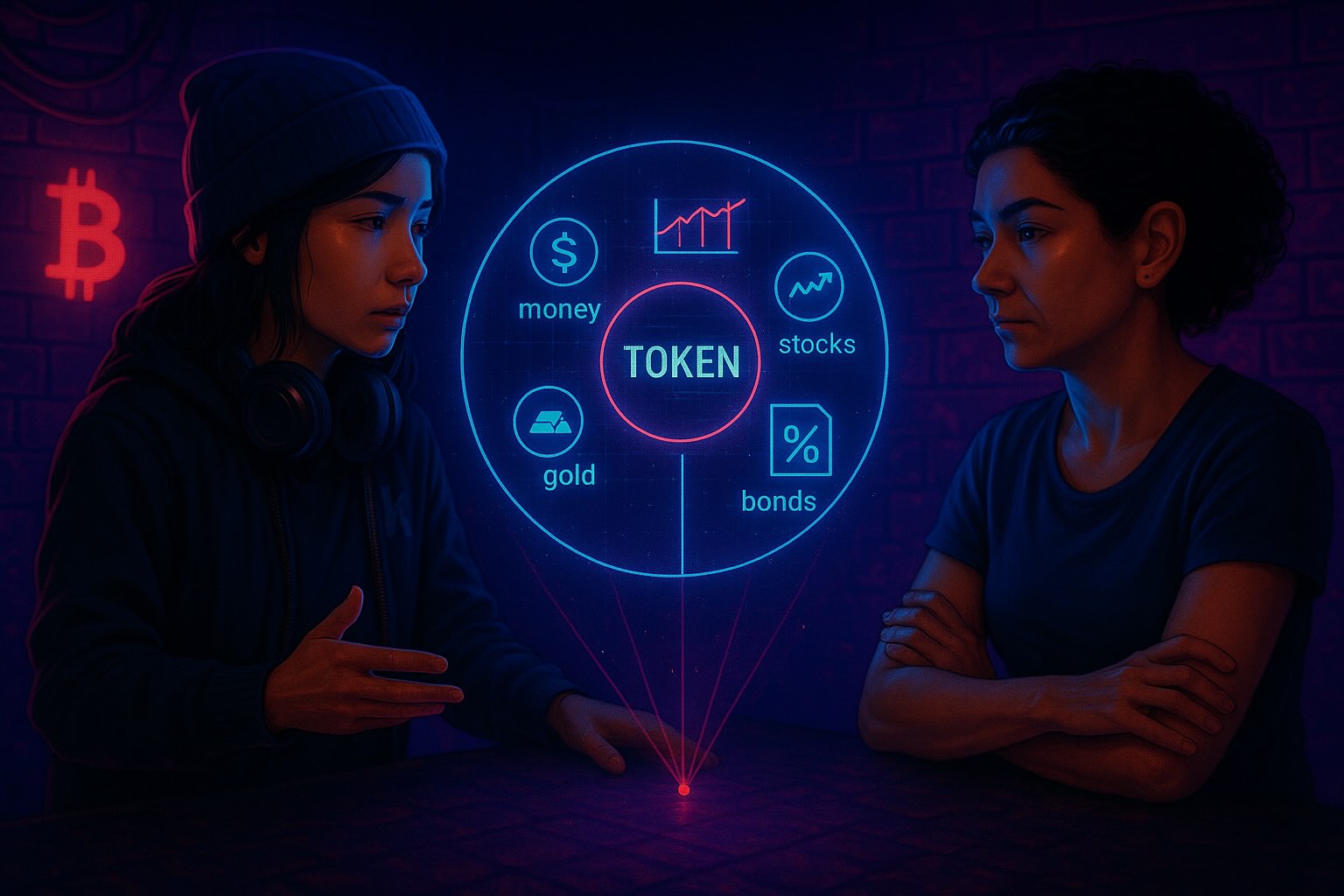
Lucia leaned back in her chair, rubbing her forehead.
“I still can’t place tokens,” she said. “They float. They don’t sit anywhere solid. If I think of money, I know it’s enforced by law. If I think of stocks, I know they tie back to a company. If I think of bonds, I know there’s a repayment contract. If I think of gold, I know it’s scarce in the ground. Tokens… they seem like shadows of all these things, but never fully any of them.”
She looked at Eunha.
“I need you to compare them directly. Piece by piece. Where do tokens mirror these assets — and where do they fail?”
Eunha nodded slowly.
“Then let’s begin with money. Tell me: what gives money its power?”
“The state,” Lucia replied. “Central banks issue it. Governments enforce it. Shops accept it because they have to. And taxes — I have to pay taxes in it. That keeps demand alive.”
“Good,” Eunha said. “Fiat money is not scarce. States can print more at will. But it is stable because authority compels its use. Tokens are different. No government forces anyone to accept them. They survive only by choice, by belief. Some tokens are designed to act like money — Bitcoin, for example: scarce, portable, global. But no court forces a shop to accept it. No law compels a debt to be settled in it. Its strength is freedom. Its weakness is fragility.”
Lucia frowned.
“So tokens can act like money, but they don’t have the state’s backbone. They live or die on voluntary belief. And belief can vanish.”
“Precisely,” Eunha said. “Tokens as money are experiments in voluntary consensus. They can work where faith endures. They collapse where faith fails.”
Lucia tapped the desk.
“And what about inflation? Governments print money endlessly. Bitcoin’s defenders say its fixed supply makes it superior. Is that fair?”
“It is both fair — and misleading,” Eunha replied. “Bitcoin’s supply is capped by code: twenty-one million, no more. That creates digital scarcity. But scarcity alone doesn’t make a currency. Stability matters too. Fiat inflates, yes — but governments can respond to crises, fund wars, stabilize banks. Bitcoin cannot flex. That rigidity is strength in theory — weakness in emergency. Money is not just numbers. It is also resilience.”
Lucia nodded, slowly.
“So Bitcoin may be the purest ‘token-as-money’ — but purity is not perfection. It trades adaptability for certainty.”
“Exactly.”
Lucia paused, then shifted.
“Alright. Then stocks. Stocks feel real — companies, workers, factories, profit. How do tokens compare?”
“A stock,” Eunha said, “is legal ownership. One share, one slice of the company. You may receive dividends. You may vote in shareholder meetings. The law enforces those rights. A token is not that. Unless it is explicitly bound by law, a token gives you no claim to profits, no legal recourse, no shareholder rights. Some projects call their tokens ‘governance shares,’ but those votes exist only in code, not in courts. They can be ignored, overridden, or made meaningless if insiders hold enough.”
Lucia shook her head.
“So when people say tokens are the new stocks, they’re really selling the image of ownership — without the rights.”
“Correct,” Eunha said. “A stock certificate comes with judges behind it. A governance token comes only with code — and sometimes, only marketing.”
“But what about tokenized stocks?” Lucia asked. “Teams claim to wrap Tesla or Apple shares as tokens. Isn’t that real?”
“Only if the wrapping is honest,” Eunha said. “A custodian must hold the real shares in a vault. The token is then a claim on those shares. But the risk is obvious: you are trusting the custodian. If they lie, the blockchain will still record your ownership faithfully — of nothing.”
Lucia exhaled sharply.
“So again: tokens can mirror stocks, but without law or trust, they’re just reflections. Sometimes accurate. Sometimes smoke.”
“Exactly.”
Lucia leaned forward.
“And bonds? Bonds seem simpler. I lend money, I get it back with interest. How can tokens pretend to be that?”
“Yet many do,” Eunha said. “Yield tokens. Lending protocols. Fixed-return promises. But bonds in the old world come with legal enforcement. If a government or company defaults, there are courts, bankruptcies, debt recovery. Tokens cannot promise that. A yield token only does what its contract allows. If the code fails, if the pool is drained, if insiders disappear — there is no courtroom.”
Lucia’s voice sharpened.
“So when a project says ‘guaranteed yield,’ the only thing guaranteed is that the code will execute — if nothing breaks, if no one exploits it, if no one drains the pool. But there is no guarantee in the traditional sense.”
“Correct,” Eunha said. “A bond rests on courts and law. A token rests on logic. Law can protect. Logic executes blindly — even if it ruins you.”
Lucia sighed.
“Then gold. Surely gold is the strongest comparison. People call Bitcoin ‘digital gold.’ Is that fair?”
“Gold is scarcity you can touch,” Eunha said. “It resists decay. It has thousands of years of monetary memory. Tokens like Bitcoin try to mimic that scarcity using math — twenty-one million, auditable by anyone. But scarcity in code is not the same as scarcity in geology. Gold cannot be printed. Bitcoin cannot either — unless the network changes its rules. Both claim permanence. Only one has physicality.”
Lucia considered this, then added:
“And what about gold’s neutrality? If I hold it, no one can freeze it. Tokens can be frozen if contracts allow, right?”
“Correct,” Eunha said. “Gold is a pure bearer asset: whoever holds it, owns it. Tokens can be bearer assets — but only if no admin key exists. If a token includes freeze or seizure functions, then your ‘digital gold’ is just digital custody pretending to be freedom.”
Lucia fell silent for a long moment, then spoke softly.
“So tokens borrow from everything — they echo money, stocks, bonds, gold — but they’re never fully those things. They are simulations. Sometimes honest. Sometimes fraudulent.”
“You see clearly,” Eunha said. “Tokens are mirrors. They reflect what they are coded to reflect. Some are honest mirrors, tied to reserves or working systems. Others are warped — showing the image of value, with nothing underneath. Both shine the same on a chart. Both are called tokens. The difference is invisible to anyone who never asks.”
Lucia leaned back, quiet now — but sharper than before.
“The real danger isn’t that tokens are nothing,” she said. “It’s that they can pretend to be anything. And most people never test the disguise.”
Eunha nodded.
“Exactly. The old world of assets anchored value in law, courts, states, or matter. Tokens replace those anchors with code. Sometimes the anchor holds. Sometimes it’s painted on. The only way to know is to ask: What is this token claiming to be — and does the design actually make it so?”
Tokens echo money, stocks, bonds, and gold — but they are never identical. They can mimic money without legal backing, stocks without rights, bonds without enforceable repayment, gold without physical weight. Their anchor is not law or matter, but code. Some are honest anchors. Many are not. To see clearly, always ask: What disguise is this token wearing — and does the code truly support the claim?